
Five ancient star patterns carry rich mythology: Orion the hunter flees through winter skies from Scorpius (they’re never visible together due to divine punishment). Cassiopeia’s W-shape represents a vain queen circling Polaris eternally. Ursa Major and Minor commemorate nymphs protected by Zeus, offering navigation aids. The Argo Navis (now divided into Carina, Puppis, and Vela) celebrates Jason’s quest. These celestial stories connect you to ancestors who found both practical guidance and profound meaning above.
Orion: The Hunter’s Eternal Chase Across the Night Sky
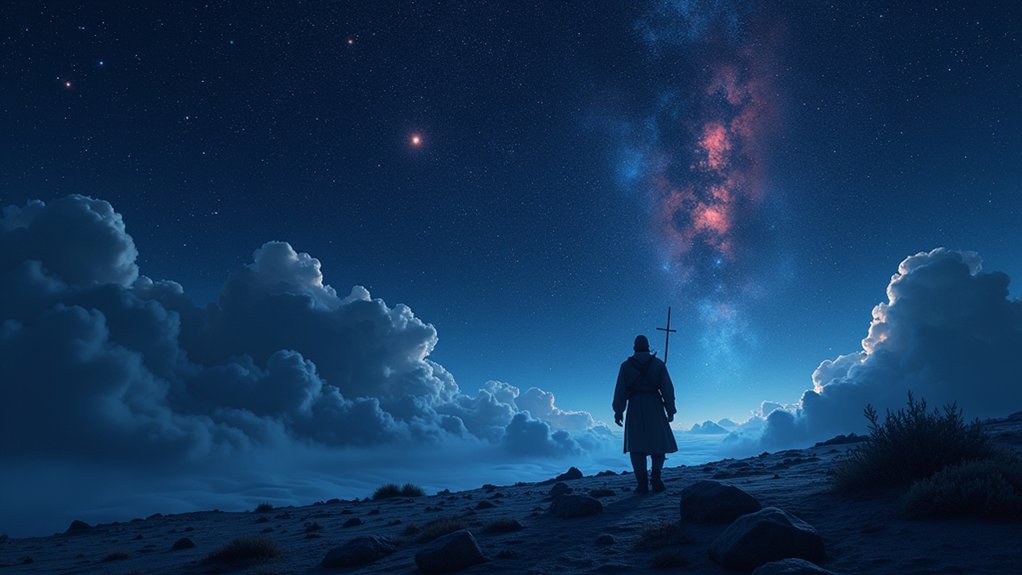
Stretching across the winter sky from November to February, Orion stands as one of humanity’s most recognizable celestial patterns, with roots reaching back to our earliest civilizations.
You’ll find this mighty hunter‘s story varying across cultures, though his identity as a celestial hunter remains consistent from Sumerian to Greek mythology.
When you gaze at Orion, you’re seeing the son of Poseidon, renowned for his strength and stature. His distinctive belt of three prominent stars makes him easy to spot, while bright Betelgeuse and Rigel mark his shoulder and foot.
The ancient hunter strides across our night sky, his three-starred belt and brilliant shoulder-to-toe stars announcing his divine lineage.
Different cultures interpret his eternal chase differently—whether he’s pursuing the Pleiades, facing off against Taurus, or heralding winter’s arrival. In ancient Egypt, the constellation was associated with Sah and Osiris, representing pharaohs in their afterlife journey.
This ancient story continues inspiring modern astronomers studying the remarkable Orion Nebula.
The Cosmic Balance: Why Scorpius and Orion Never Share the Sky
While Orion dominates winter skies with his bold presence, you’ll never see him sharing the celestial stage with Scorpius—and this astronomical quirk has roots in ancient mythology.
This celestial separation stems from the tale where boastful Orion claimed he could kill every animal on Earth, angering Gaia who sent a lethal scorpion as punishment. Zeus immortalized their conflict by placing them on opposite sides of the sky, ensuring their eternal separation.
Only during a brief window in late May to early June can you glimpse both partially—Orion setting in the west as Scorpius rises in the east. The setting western sun creates dramatic dust-filled skies that enhance this rare astronomical viewing opportunity.
Their positioning reflects perfect cosmic balance, with Antares (Scorpius’ heart) and Betelgeuse (Orion’s shoulder) sharing similar reddish hues like distant rivals mirroring each other.
Cassiopeia’s Vanity: A Queen’s Punishment Written in Stars
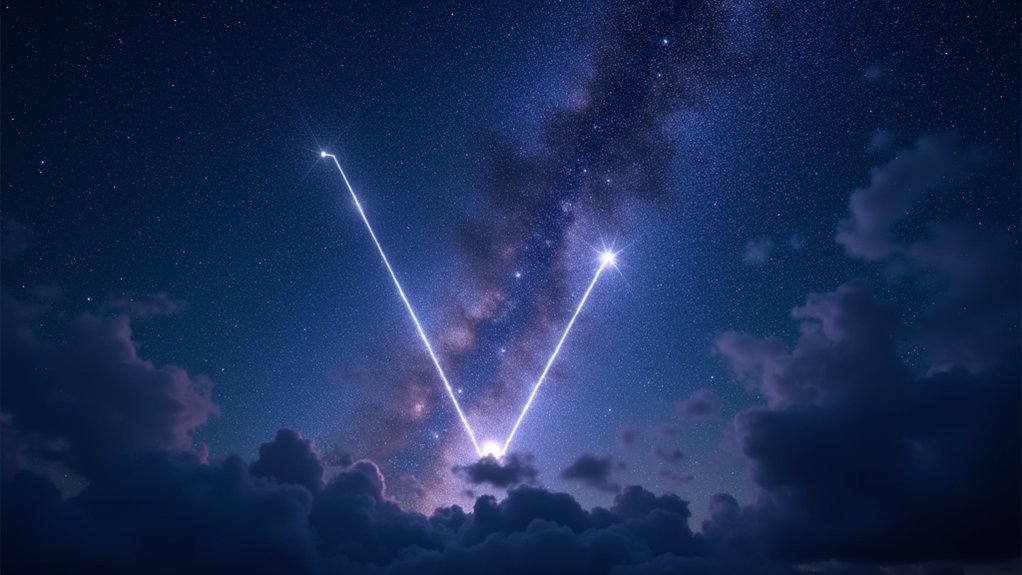
When you gaze up at the northern night sky, you’ll spot a distinctive W-shaped constellation that tells one of mythology’s most enduring tales of vanity and divine retribution.
This is Cassiopeia, the beautiful but arrogant queen of Aethiopia who boasted that she and her daughter Andromeda surpassed even the sea nymphs in beauty.
Her hubris angered Poseidon, who sent the sea monster Cetus to ravage her kingdom. To appease the god, Andromeda was chained to a cliff as sacrifice.
Though Perseus eventually rescued the princess, Cassiopeia couldn’t escape punishment. The gods placed her among the stars, forced to circle Polaris eternally. The constellation has been recognized by various ancient civilizations including the Egyptian and Chinese cultures, each with their own interpretations.
For half the year, she hangs upside down on her throne—a humbling reminder of the consequences of pride.
The Great Bears: How Ursa Major and Minor Protected Nymphs
Among the most distinctive patterns in the northern night sky, Ursa Major and Ursa Minor—the Great Bear and Little Bear—tell an ancient tale of divine protection and transformation.
You’re witnessing the immortalized forms of Callisto, a nymph changed into a bear by Artemis or Hera, and possibly her son Arcas.
These celestial bears serve practical purposes beyond their mythological origins. When you locate the Big Dipper within Ursa Major, you’ll find it points toward Polaris in Ursa Minor, providing reliable navigation across hemispheres. In Ursa Minor, you’ll find the fainter Little Dipper asterism formed by seven stars that requires good viewing conditions to see fully.
The constellations’ prominence led Thales of Miletus to introduce them to Greek astronomy.
As you gaze upward, you’re seeing the same patterns that guided Phoenician sailors and inspired countless cultures to create stories of divine power, vulnerability, and familial bonds.
Celestial Ships and Heroes: The Story of Argo Among the Stars

The ancient constellation Argo Navis sails eternally through the southern night sky, commemorating one of mythology’s greatest adventures. Though no longer officially recognized as a single constellation, its legacy continues through its three parts: Carina, Puppis, and Vela.
You’ll find the story of Jason and the Argonauts embedded in these stars. Their ship, built by Argus under Athena’s guidance, carried them on their quest for the Golden Fleece.
In ancient celestial symbolism, Argo features a distinctive Lion figurehead looking toward the constellation Leo, representing anticipation of what lies ahead on the cosmic journey.
| Aspect | Original Argo Navis | Modern Division |
|---|---|---|
| Size | Among largest constellations | Split into three |
| Brightest Star | Canopus (310 light-years away) | Now in Carina |
| Mythological Role | Jason’s quest vessel | Same story remains |
| Navigation Use | Ancient wayfinding | Still guides sailors |
| Cultural Impact | Spans Greek, Egyptian, Hebrew traditions | Influences continued |
Frequently Asked Questions
How Did Different Cultures Navigate Using These Star Patterns?
You’ll find different cultures navigated using star patterns by creating mental star maps, inventing tools like astrolabes, aligning constellations with directions, and combining stellar observations with wind patterns and ocean currents.
Can Constellation Myths Predict Natural Disasters or Weather Patterns?
No, constellation myths can’t predict natural disasters or weather patterns. While you’ll find these stories fascinating, they’re cultural explanations rather than scientific forecasts. Modern science provides reliable predictions through environmental data instead.
Why Do Some Cultures See Dark Spaces Instead of Stars?
You’ll notice some cultures focus on dark spaces because they’re highly visible in unpolluted skies. These gaps form recognizable patterns that help with navigation, storytelling, and preserving traditional knowledge systems through generations.
How Did Constellation Stories Evolve From Babylonian to Greek Mythology?
You’ll notice Babylonian constellations passed to Greeks through trade and cultural exchange. They kept astronomical groupings but reimagined myths, replacing Babylonian gods with their pantheon’s heroes and deities in their own narratives.
Are There Constellations Representing Important Female Figures Besides Cassiopeia?
Yes, you’ll find Virgo (the Maiden) and Andromeda (the Chained Princess) representing significant female figures alongside Cassiopeia. These are the main female constellations among the 88 recognized modern constellations.
In Summary
When you gaze at these ancient constellations, you’re not just seeing stars—you’re witnessing stories that have captivated humanity for millennia. From Orion’s eternal hunt to Cassiopeia’s celestial punishment, these patterns carry the myths, beliefs, and imaginations of our ancestors. They’ll continue to inspire wonder as you connect with the same night sky that’s guided countless generations before you. The stars aren’t just distant suns—they’re timeless storytellers.