
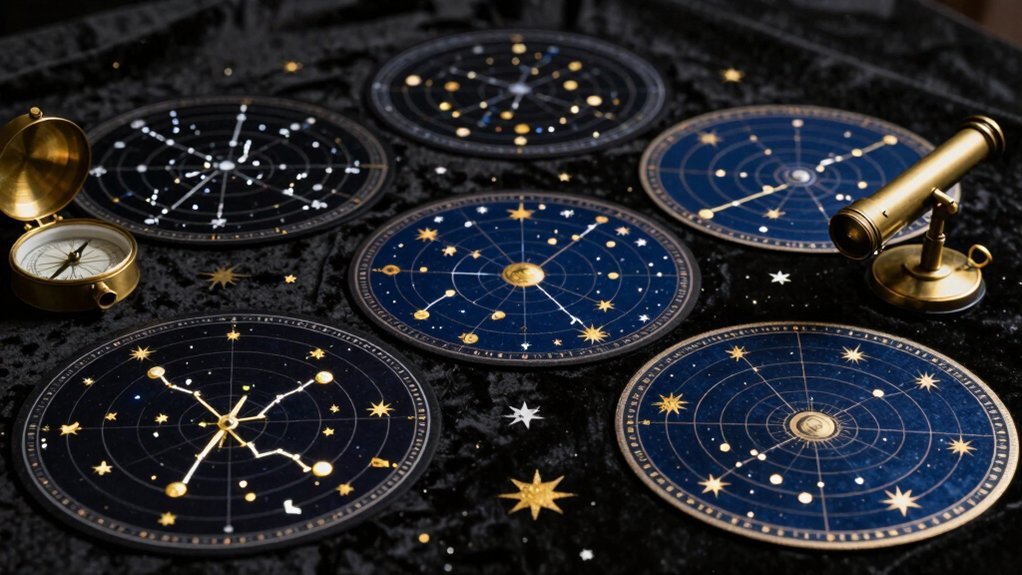
You’re planning your stargazing sessions for 2026, but you’re unsure which star chart will actually serve your needs. Should you choose a traditional planisphere, a glow-in-the-dark option, or a rotating model? Each offers distinct advantages depending on your location, experience level, and intended use. Finding the right fit requires understanding what sets these five top contenders apart.
| Double-Sided Planisphere Star Map Night Sky Guide |  | Best for Stargazers | Primary Format: Rotating planisphere device | Size/Dimensions: 12.87 x 9.21 inches | Coverage Area: Equator to 60°N latitude | CHECK ON AMAZON | Read Our Analysis |
| The Constellations Glow-in-The-Dark Star Map (Northern Hemisphere) |  | Best for Kids | Primary Format: Glow-in-the-dark wall poster | Size/Dimensions: 24 x 28.5 inches | Coverage Area: Northern Hemisphere (North America, Europe, Asia) | CHECK ON AMAZON | Read Our Analysis |
| Maps International Glow in Dark Constellation Map |  | Best Wall Display | Primary Format: Glow-in-the-dark wall poster | Size/Dimensions: 33 x 23 inches | Coverage Area: Northern Hemisphere | CHECK ON AMAZON | Read Our Analysis |
| WEISUYUUS Rotating Star Chart Map for Astronomy Enthusiasts |  | Best Portable Guide | Primary Format: Rotating star chart device | Size/Dimensions: Portable/compact size | Coverage Area: 30-50°N latitude | CHECK ON AMAZON | Read Our Analysis |
| Chart of the Heavens Constellations Astronomy Map Poster |  | Best Vintage Aesthetic | Primary Format: Printed wall poster | Size/Dimensions: 36 x 24 inches | Coverage Area: Northern and Southern Hemisphere | CHECK ON AMAZON | Read Our Analysis |
More Details on Our Top Picks
Double-Sided Planisphere Star Map Night Sky Guide
Are you seeking a reliable tool that won’t distort the night sky’s layout? The Double-Sided Planisphere Star Map delivers. This innovative design flips to minimize polar projection distortion, letting you identify constellations accurately across the Northern Hemisphere between the equator and 60°N. Celestial cartographer Wil Tirion crafted these detailed maps showing constellations, variable stars, clusters, nebulae, and galaxies. You’ll find the ecliptic line and Milky Way band marked for reference. The durable plastic construction withstands regular use, with rotating components secured by brass rivets. Made in the USA with responsive customer support, it’s earned impressive 4.6/5 ratings from over 110 reviewers.
- Primary Format:Rotating planisphere device
- Size/Dimensions:12.87 x 9.21 inches
- Coverage Area:Equator to 60°N latitude
- Made in USA:Yes
- Educational Level:Intermediate to advanced astronomers
- Special Features:Double-sided design, brass rivets, ecliptic line, Milky Way band
- Additional Feature:Double-sided distortion-reducing design
- Additional Feature:Brass rivet rotating components
- Additional Feature:Crafted by celestial cartographer
The Constellations Glow-in-The-Dark Star Map (Northern Hemisphere)
If you’re seeking a star chart that doubles as functional decor, The Constellations Glow-in-The-Dark Star Map delivers an engaging option for stargazers and kids alike. This 24 x 28.5-inch map showcases major constellations visible year-round from North America, Europe, and Asia. After exposure to lamplight, it glows for hours, creating a mesmerizing nighttime effect where constellation lines fade while stars and the Milky Way brilliantly shine through. You’ll appreciate its dual purpose as both an educational tool and night light. Made in the USA and shipped in a protective heavy-duty tube, it’s ideal for bedroom walls or above beds.
- Primary Format:Glow-in-the-dark wall poster
- Size/Dimensions:24 x 28.5 inches
- Coverage Area:Northern Hemisphere (North America, Europe, Asia)
- Made in USA:Yes
- Educational Level:General educational/children
- Special Features:Glow-in-dark for many hours, night light function
- Additional Feature:Glows for many hours
- Additional Feature:Functions as night light
- Additional Feature:Heavy-duty tube delivery
Maps International Glow in Dark Constellation Map
Looking to combine education with nighttime wonder? Maps International’s Glow in Dark Constellation Map delivers both. This 33 x 23-inch poster charges during daylight hours, then illuminates brilliantly after dark, transforming your bedroom or classroom ceiling into an interactive learning tool. The map includes detailed educational instructions for optimal use. Its generous size makes it perfect for wall or ceiling display, and it arrives rolled in a tube—crease-free and ready to hang. Whether you’re seeking comfort for children afraid of the dark or a unique educational gift, this map embodies Maps International’s commitment to cartographic excellence and high-quality design.
- Primary Format:Glow-in-the-dark wall poster
- Size/Dimensions:33 x 23 inches
- Coverage Area:Northern Hemisphere
- Made in USA:Not specified
- Educational Level:General educational/children
- Special Features:Glow-in-dark after light exposure, ceiling/wall mountable
- Additional Feature:Extra large 33×23 inches
- Additional Feature:Creaseless tube delivery
- Additional Feature:Educational instructions included
WEISUYUUS Rotating Star Chart Map for Astronomy Enthusiasts
The WEISUYUUS Rotating Star Chart Map stands out as the ideal choice for anyone seeking a practical, all-in-one stargazing companion that doesn’t require annual updates. You’ll align the date and time, then rotate the chart to reveal what’s directly overhead—simple and effective. This tool educates you on constellations, bright stars, and over 100 star clusters and galaxies, making it valuable whether you’re a beginner or experienced astronomer. Designed for 30–50 degree northern latitudes, it works year-round without calendar limitations. You can use it with binoculars or telescopes, enhancing your observations significantly. It’s portable, user-friendly, and built specifically for serious stargazers wanting reliable guidance.
- Primary Format:Rotating star chart device
- Size/Dimensions:Portable/compact size
- Coverage Area:30-50°N latitude
- Made in USA:Not specified
- Educational Level:Beginners to advanced enthusiasts
- Special Features:100+ star clusters/galaxies, compatible with telescopes/binoculars
- Additional Feature:Shows 100 star clusters/galaxies
- Additional Feature:30-50 degree northern latitudes
- Additional Feature:Compatible with telescopes/binoculars
Chart of the Heavens Constellations Astronomy Map Poster
Want a historically authentic star chart that’ll transform your space into an observatory? This 1892 engraving captures celestial maps for both Northern and Southern hemispheres with stunning detail. The 36×24-inch poster arrives printed on premium acid-free paper with a low-glare satin finish, ensuring fade resistance and photo-quality clarity. Made in the USA and officially NASA-licensed, it’s expertly rolled and packed for easy hanging. Whether you’re decorating your bedroom, office, or classroom, this gallery-worthy piece brings astronomical authenticity to any room. At 4.1 stars, it’s proven popular among educators and space enthusiasts alike.
- Primary Format:Printed wall poster
- Size/Dimensions:36 x 24 inches
- Coverage Area:Northern and Southern Hemisphere
- Made in USA:Yes
- Educational Level:General educational/classroom
- Special Features:1892 engraving design, NASA licensed, fade-resistant paper
- Additional Feature:Satin finish photo quality
- Additional Feature:NASA officially licensed
- Additional Feature:Acid-free fade resistant paper
Factors to Consider When Choosing a Northern Hemisphere Star Chart
When you’re selecting a Northern Hemisphere star chart for 2026, you’ll want to evaluate several key factors that’ll impact your stargazing experience. Consider the latitude range and coverage that matches your location, the material’s durability and design quality, the educational features and detail level you need, the size and display options that fit your space, and whether glow features and functionality enhance your nighttime observations. Each of these elements plays a crucial role in determining whether a chart will serve your astronomical interests effectively.
Latitude Range And Coverage
Why does latitude matter so much when you’re selecting a star chart? Your location determines which constellations and celestial objects you’ll actually see. Most planispheres target 0° to 60°N, covering most northern hemisphere users, but you should verify the chart’s specific latitude range matches yours.
You’ll also want to check the magnitude coverage—this indicates how faint the stars are that the chart displays. Fainter objects require darker skies and better equipment to spot, so knowing this helps you set realistic expectations.
Double-sided designs reduce distortion near the poles, making them ideal if you’re at higher northern latitudes. Additionally, ensure the chart clearly marks east-west and north-south orientation so you can properly align it to your exact location and latitude.
Material Durability And Design
A star chart’s longevity depends heavily on the materials and construction quality you choose. Plastic planispheres with brass rivets offer durability and reliable rotation, while wipe-clean surfaces withstand repeated use without damage. Double-sided designs reduce distortion by avoiding polar-centered projections, improving accuracy across different latitudes.
Consider luminescent or glow-in-the-dark features for nighttime observation, though these elements can wear unevenly with prolonged light exposure. Evaluate size carefully—larger charts provide greater detail but sacrifice portability, while compact versions offer convenience at the cost of readability.
Don’t overlook packaging either. Rolling or tube packaging protects your map during shipping and storage, preventing creases and preserving print integrity. These protective measures ensure your investment remains in excellent condition for years of stargazing.
Educational Features And Detail
How much detail you need in your star chart depends on your learning goals and observing experience. If you’re beginning stargazing, look for charts that clearly label constellations, major celestial objects like nebulae and galaxies, and magnitude scales showing star brightness. Planispheres with date- and time-based visibility teach you where constellations appear overhead throughout the year. Glow-in-the-dark formats work well for nighttime learning, revealing stars and the Milky Way in low light. Multi-latitude designs reduce distortion and expand your learning beyond the Northern Hemisphere alone. Seek charts with clear usage guidance, including latitude alignment indicators and the ecliptic line marked. These features transform a basic map into a comprehensive educational tool tailored to your observing needs.
Size And Display Options
Once you’ve identified the educational features you need, consider where and how you’ll display your star chart. Larger formats like 33 x 23 inches or 36 x 24 inches deliver superior readability and detail, though they demand substantial wall or ceiling space. Standard poster sizes (24 x 28.5 inches) arrive rolled and tube-shipped, simplifying mounting. Double-sided planispheres let you flip between different latitude ranges, maximizing your display’s versatility. If you plan nighttime viewing, glow-in-the-dark and luminous prints eliminate the need for auxiliary lighting. Finally, invest in high-resolution artwork printed on ANSI/acid-free paper to ensure your chart remains vibrant and undamaged throughout years of display and use.
Glow Features And Functionality
When you’re observing the night sky from your bedroom or classroom, glow-in-the-dark star charts transform your viewing experience by eliminating the need for external lighting. You’ll find that glow intensity and duration depend heavily on the phosphorescent material quality and prior light exposure. After charging under lamp light during the day, many maps remain visible for hours into darkness.
You’ll notice glow modes enhance contrast by brightening stars and the Milky Way while constellation lines fade, sharpening your focus on celestial objects. These maps work year-round for northern hemisphere stargazing, serving dual purposes as educational tools and functional night lights. Consider your specific needs—whether you prioritize educational value or practical nighttime visibility—when selecting a chart with glow functionality.
Frequently Asked Questions
How Do Seasonal Changes Affect Which Constellations Are Visible Throughout 2026?
You’ll see different constellations throughout 2026 because Earth’s orbit changes your viewing angle. Winter reveals distant winter constellations, while summer rotates your sky toward different stars. You’re always turning away from some constellations and toward others.
What Is the Best Time of Night to Use Star Charts for Optimal Viewing Conditions?
You’ll achieve optimal viewing conditions between midnight and dawn when the sky reaches its darkest point. You should avoid moonlit nights and light pollution by traveling away from cities. You’ll spot fainter constellations most clearly during these ideal hours.
How Do Light Pollution Levels Impact the Effectiveness of Different Star Chart Types?
You’ll find detailed star charts become less effective in high light pollution areas since fainter stars disappear. You’d benefit from using simplified charts showing only bright stars, or relocating to darker skies for comprehensive mapping.
Can I Use Northern Hemisphere Star Charts at Different Latitudes With Accuracy?
You’ll find accuracy decreases considerably as you move away from your chart’s designed latitude. You’re best served using charts specifically calibrated for your location, though general Northern Hemisphere charts work reasonably well within fifteen degrees of your position.
What Astronomical Events in 2026 Require Supplementary Resources Beyond Standard Star Charts?
You’ll need specialized resources for eclipses, planetary conjunctions, and occultations. Standard charts won’t show precise timing, shadow paths, or magnitude predictions. You’ll want dedicated eclipse maps, planetary position tables, and real-time software for accurate observations.

Leave a Reply