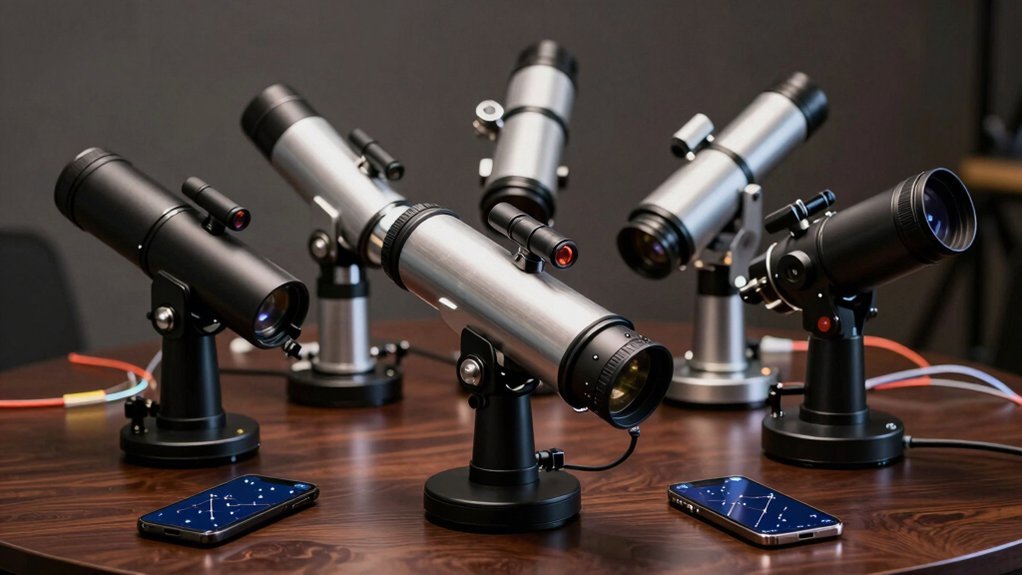
You’re probably wondering if a WiFi-enabled telescope actually improves your stargazing experience. The answer isn’t straightforward—it depends on what you value most. Whether you’re after portability, professional-grade optics, or beginner-friendly features, you’ll find distinct advantages and trade-offs across these five options. Let’s explore what makes each one stand out.
| ZWO Seestar S50 Smart Digital Telescope All-in-One |  | Best All-in-One | App Control: Seestar APP with EQ, Plan, and Mosaic modes | Portability: 2.5 kg; compact all-in-one design | Auto-Tracking/GoTo: Full-automatic find & track via phone | CHECK ON AMAZON | Read Our Analysis |
| DWARFLAB Dwarf 3 Smart Telescope with 4K Auto-Tracking |  | Most Portable | App Control: DWARFLAB App with cloud processing | Portability: 1.35 kg; fits standard backpack | Auto-Tracking/GoTo: 4K smart auto-tracking for celestial objects | CHECK ON AMAZON | Read Our Analysis |
| Celestron SkyPortal WiFi Module Telescope Control Accessory |  | Best Accessory | App Control: SkyPortal App (100,000+ celestial objects) | Portability: Accessory module only (1.44 oz) | Auto-Tracking/GoTo: Wireless telescope slewing control | CHECK ON AMAZON | Read Our Analysis |
| Celestron StarSense Explorer DX 5-inch App-Enabled Telescope |  | Best Beginner-Friendly | App Control: StarSense Explorer App with sky recognition | Portability: Portable with manual mount | Auto-Tracking/GoTo: StarSense patented sky recognition alignment | CHECK ON AMAZON | Read Our Analysis |
| Celestron NexStar Evolution 8 WiFi Computerized Telescope |  | Best Premium Choice | App Control: SkyPortal App with smartphone control | Portability: Improved carry handles; integrated design | Auto-Tracking/GoTo: Computerized GoTo with automatic tracking | CHECK ON AMAZON | Read Our Analysis |
More Details on Our Top Picks
ZWO Seestar S50 Smart Digital Telescope All-in-One
Are you looking for a telescope that doesn’t require you to master complex equipment before you can start observing? The ZWO Seestar S50 offers an all-in-one solution that integrates a telescope, camera, mount, and focuser into a compact 2.5 kg package. You’ll control everything through your smartphone, accessing thousands of celestial targets via the live star database. The professional-grade triplet apochromatic optics deliver crisp images with minimal chromatic aberration, while three specialized modes—EQ, Plan, and Mosaic—let you customize your imaging approach. Whether you’re a beginner or experienced observer, you’ll appreciate the automatic tracking, voice progress updates, and seamless connectivity that make astrophotography accessible and enjoyable.
- App Control:Seestar APP with EQ, Plan, and Mosaic modes
- Portability:2.5 kg; compact all-in-one design
- Auto-Tracking/GoTo:Full-automatic find & track via phone
- Imaging Quality:Low-noise images; triplet apochromatic optics
- User Experience Level:Suitable for beginners and experienced users
- Power Source:Integrated all-in-one system (battery implied)
- Additional Feature:Multiple imaging modes (EQ/Plan/Mosaic)
- Additional Feature:Automatic panorama stitching capability
- Additional Feature:Voice broadcast progress reports
DWARFLAB Dwarf 3 Smart Telescope with 4K Auto-Tracking
Want to start astrophotography in two minutes without lugging around heavy equipment? The DWARFLAB Dwarf 3 delivers exactly that. This ultra-portable 3-pound smart telescope fits in your backpack and features dual imaging systems—telephoto and wide-angle lenses—for wildlife, landscapes, and deep-space objects. Its 4K auto-tracking capability locks onto celestial bodies and moving subjects automatically, while cloud-powered processing handles enhancement instantly through the app. No PC required. The intuitive interface suits everyone from age six to ninety-eight, making astrophotography genuinely accessible. You’ll appreciate the daytime capability too, switching seamlessly between telephoto for subjects and wide-angle for target location. With a 4.7-star rating from 102 reviews, it’s proven itself essential for adventure-ready stargazers.
- App Control:DWARFLAB App with cloud processing
- Portability:1.35 kg; fits standard backpack
- Auto-Tracking/GoTo:4K smart auto-tracking for celestial objects
- Imaging Quality:4K clarity with dual imaging system
- User Experience Level:Beginner to expert friendly; ages 6–98
- Power Source:Lithium-ion battery included
- Additional Feature:Dual telephoto/wide-angle lens system
- Additional Feature:Day and night imaging capability
- Additional Feature:Cloud-powered one-touch enhancement
Celestron SkyPortal WiFi Module Telescope Control Accessory
If you’re an amateur astronomer who’d rather control your telescope from your smartphone than fumble with hand controllers in the dark, the Celestron SkyPortal WiFi Module transforms your device into a wireless telescope guide. You’ll tap objects to identify them, then slew and center them in your eyepiece instantly. The free SkyPortal app features a database of over 100,000 celestial objects with audio descriptions and a Sky Tour function that generates optimal viewing lists for your location and time. It’s compatible with most modern Celestron mounts—though notably absent from NexStar i Series support—and provides 100-year transit planning capabilities for serious observing sessions.
- App Control:SkyPortal App (100,000+ celestial objects)
- Portability:Accessory module only (1.44 oz)
- Auto-Tracking/GoTo:Wireless telescope slewing control
- Imaging Quality:N/A (accessory module)
- User Experience Level:Works with existing Celestron telescopes
- Power Source:Powered via telescope connection
- Additional Feature:100,000+ celestial object database
- Additional Feature:Audio descriptions for popular objects
- Additional Feature:100-year transit/event planning
Celestron StarSense Explorer DX 5-inch App-Enabled Telescope
Looking to get started with telescope astronomy without the steep learning curve? The Celestron StarSense Explorer DX 5-inch offers exactly that. You’ll dock your smartphone, launch the StarSense app, and follow on-screen arrows to locate celestial targets. Its patented sky recognition technology analyzes star patterns to pinpoint your telescope’s position automatically. The app curates tonight’s best viewing targets based on your location and time. With a 5-inch Schmidt-Cassegrain optical design and StarBright XLT coatings, you’ll enjoy sharp, vivid views of the Moon, Jupiter, Saturn, and deep-sky objects like the Orion Nebula. The manual altazimuth mount features dual-axis slow-motion controls for smooth tracking. Celestron backs it with a 2-year warranty and US-based support.
- App Control:StarSense Explorer App with sky recognition
- Portability:Portable with manual mount
- Auto-Tracking/GoTo:StarSense patented sky recognition alignment
- Imaging Quality:Sharp, vivid views with StarBright XLT coatings
- User Experience Level:Easy-to-use for beginners
- Power Source:Manual altazimuth mount (no battery specified)
- Additional Feature:Patented sky recognition technology
- Additional Feature:Built-in smartphone dock integration
- Additional Feature:On-screen arrow guidance system
Celestron NexStar Evolution 8 WiFi Computerized Telescope
The Celestron NexStar Evolution 8 stands out for astronomers who demand both portability and serious observing power. You’ll control this 8-inch Schmidt-Cassegrain telescope entirely through your smartphone using the SkyPortal app, letting you locate and track objects automatically. The built-in 10-hour lithium battery eliminates external power requirements, while brass worm gears ensure smooth tracking accuracy. StarBright XLT coatings deliver enhanced optical performance, and integrated carry handles make transportation effortless. Two accessory trays provide convenient organization. You’ll find this telescope ideal for star parties and astrophotography sessions where WiFi connectivity enables remote operation.
- App Control:SkyPortal App with smartphone control
- Portability:Improved carry handles; integrated design
- Auto-Tracking/GoTo:Computerized GoTo with automatic tracking
- Imaging Quality:StarBright XLT optical coatings
- User Experience Level:Ideal for star parties and astroimaging
- Power Source:Built-in 10-hour LiFePO4 battery
- Additional Feature:Built-in 10-hour LiFePO4 battery
- Additional Feature:USB phone charging port included
- Additional Feature:Brass worm gear tracking motors
Factors to Consider When Choosing a Wifi-Enabled Telescope
When you’re shopping for a WiFi-enabled telescope, you’ll want to balance portability with optical performance, ensuring the model fits your lifestyle and observing needs. Consider how intuitive the app controls are, what smart features matter most to you, and whether the battery life supports your typical viewing sessions. Finally, assess whether you’re a beginner seeking user-friendly automation or an advanced astronomer who values manual control and professional-grade optics.
Portability And Weight Considerations
How much weight are you willing to carry to your observation site? That’s the first question you should ask yourself when evaluating portability. Ultra-light models weighing around 1.35 kg fit easily into backpacks, while heavier options at 2.5 kg or more include integrated mounts and cameras, reducing what you’ll need to pack separately.
You’ll appreciate compact dimensions paired with included travel cases that minimize bulk during transit. All-in-one designs streamline your setup by combining tripod, mount, and power solutions into single units, eliminating multiple carrying items.
Battery-powered operation proves invaluable for field use, freeing you from hunting external power sources. Consider your typical observation locations and distances you’ll travel. Lighter telescopes enhance spontaneous stargazing trips, while integrated systems offer convenience despite extra weight.
App Control And Smart Features
What truly sets WiFi-enabled telescopes apart from traditional models? The app control and smart features you’ll access through your smartphone. You can manage wireless go-to functions, tracking, and live imaging directly from your device without needing a PC nearby.
Quality apps offer automated target planning, sky tours, and Tonight’s Best lists tailored to your location and observing time. Some systems include cloud processing and AI-assisted image enhancement, streamlining your workflow considerably. You’ll find advanced modes like EQ tracking, mosaic stitching, and voice progress updates that automate repetitive tasks.
Before purchasing, verify app compatibility with your specific telescope model and control ports. Not all apps support every mount or firmware version, so checking system requirements prevents frustration and ensures seamless operation.
Optical Quality And Image Clarity
Optical performance ultimately determines whether you’ll capture stunning deep-sky details or disappointing, fuzzy images. When evaluating WiFi-enabled telescopes, prioritize triplet apochromatic optics, which minimize chromatic aberration and deliver crisp images across the entire spectrum.
High-quality lens coatings are equally critical—they reduce light loss, enhancing contrast and brightness when observing faint astronomical targets. You’ll appreciate the difference in low-light conditions.
Modern 4K auto-tracking sensors combined with integrated autofocus and adaptive optics maintain optimal focus throughout extended observation sessions. These features eliminate manual adjustments, ensuring consistent image clarity.
Additionally, plan-mode and mosaic capabilities let you stitch multiple high-resolution frames together, expanding your field-of-view while preserving detail. This combination of optical excellence and intelligent imaging technology ensures you’re getting the best possible views of the night sky.
Battery Life And Power Options
You’ll want to carefully evaluate a WiFi-enabled telescope’s power capabilities, since they directly impact how long you can observe without interruption. Battery life varies significantly by model, with some offering up to 10 hours of operation on a single charge. Built-in rechargeable batteries eliminate the need for external power supplies during mobile sessions, though you should consider runtime under typical conditions—tracking, WiFi usage, and motor activity all drain power.
When assessing options, examine battery capacity and discharge rates. Many models feature USB charging ports for convenient field recharging, while some support external power packs or solar charging. Calculate your planned session length and select a telescope whose power specifications exceed your requirements, ensuring uninterrupted observing time throughout your astronomy sessions.
Beginner Versus Advanced User Suitability
Once you’ve confirmed that a telescope’s battery life meets your observing needs, the next consideration is whether the model suits your experience level. If you’re just starting out, you’ll want automated targeting, simple app interfaces, and guided workflows that minimize setup complexity. Look for built-in star databases and “Tonight’s Best” target lists to jump into observing quickly. Advanced users, however, require precise GoTo performance, equatorial tracking options, and customizable imaging sequences. You’ll likely need plan or mosaic modes, EQ compatibility, and external app support for complex projects. Beginners benefit most from intuitive charging and clear progress feedback, while advanced observers prioritize stable, low-latency wireless connections for real-time control during imaging sessions.
Budget And Price Point Alignment
WiFi-enabled telescopes span a wide range of price points, and you’ll find that cost often correlates directly with integrated features like built-in batteries, GoTo systems, and app compatibility. You should evaluate whether essential functions meet your needs before justifying premium pricing for upgrades like advanced coatings or enhanced optics.
Consider that companion apps with autonomous planning and target lists can justify higher costs through automation benefits. However, discontinued WiFi modules may offer lower prices at the trade-off of reduced support and reduced compatibility with newer smartphones.
Factor in potential ongoing expenses too—cloud processing, data plans, and device requirements can add hidden costs. Weigh these considerations carefully to ensure your investment aligns with your observing goals and budget constraints.
Warranty And Long-Term Support
Beyond evaluating upfront costs, protecting your investment requires understanding what happens after you’ve made your purchase. You’ll want to confirm the warranty duration—look for at least a 2-year US warranty covering both hardware and software components, including wifi-enabled features and app-based control. Verify that the manufacturer commits to ongoing firmware and app updates, ensuring compatibility with new devices and operating systems. Check for authorized service centers or accessible customer support channels in your region for reliable long-term assistance. Additionally, confirm whether the warranty transfers if you sell or gift the telescope, safeguarding the new owner’s coverage. These protections transform your telescope into a secure, supported investment.
Frequently Asked Questions
Do Wifi-Enabled Telescopes Require Monthly Subscription Fees or Internet Service Plans?
You don’t necessarily need monthly subscriptions, but you’ll require an internet connection to use WiFi features. Some manufacturers offer optional premium apps or cloud services, though basic connectivity through your home network won’t cost extra.
How Does Poor Weather or Cloud Cover Affect Wifi Telescope Auto-Tracking Capabilities?
Cloud cover and poor weather substantially impair your telescope’s auto-tracking by blocking the GPS signals and star-recognition software it relies on. You’ll need to manually adjust positioning until conditions improve.
What Is the Typical Lifespan and Warranty Coverage for Smart Telescope Components?
You’ll typically find smart telescope components lasting 5-10 years with standard warranties covering 1-2 years. You can extend coverage through manufacturer plans, protecting your investment against hardware failures and sensor degradation over time.
Can Wifi Telescopes Be Used Offline or Do They Need Constant Connectivity?
You can operate most WiFi telescopes offline, though you’ll lose app connectivity and smart features. Basic manual functions work independently, but you won’t access computerized tracking, remote controls, or software updates without internet connection.
Are Wifi-Enabled Telescopes Suitable for Beginners With No Astronomy Experience?
Yes, you’ll find WiFi-enabled telescopes excellent for beginners. They’re user-friendly because you’re controlling them through smartphone apps with intuitive interfaces. You’ll locate celestial objects easily, and you won’t need extensive astronomy knowledge to get started observing.